The 650-Year-Old Sandal Found in a Bearded Vulture’s Nest in Spain
Quick Answer: Researchers studying 12 abandoned bearded vulture nests in southern Spain found 226 human-made remains among 2,483 recovered materials. One of the most remarkable discoveries was a complete sandal made from esparto grass and dated to 674 ± 22 radiocarbon years Before Present, corresponding to the late 13th century. The nests had preserved a surprising record of both wildlife and past human activity.
Introduction
Some archaeological discoveries are made in carefully excavated settlements, caves, graves, or ancient buildings. Others are found in places that were never built by humans at all.
In southern Spain, researchers examining abandoned bearded vulture nests discovered that the birds had unintentionally preserved fragments of human history alongside the bones, feathers, eggshells, and nesting materials accumulated over generations.
Among the discoveries was a complete piece of rough footwear made from grass and twigs. Radiocarbon analysis dated the sandal to 674 ± 22 years Before Present, with the study placing it in the late 13th century. That is the scientific measurement behind the widely reported “650-year-old sandal” description.
The discovery is more than an unusual archaeological curiosity. It shows how a bird’s long-term nesting behavior can create a natural archive containing clues about past animals, landscapes, materials, and human activity.
 |
An illustrative depiction of a bearded vulture beside a woven sandal in a cliffside nest, inspired by the documented discovery of a sandal radiocarbon-dated to 674 ± 22 years BP in southern Spain. Illustration: The Pader. |
- Bird: Bearded vulture (Gypaetus barbatus)
- Study area: Southern Spain
- Nests examined: 12 abandoned historical nests
- Materials recovered: 2,483 remains
- Human-made remains: 226, or about 9.1% of the total
- Remarkable find: A complete esparto-grass sandal
- Radiocarbon result: 674 ± 22 years BP
- Approximate period: Late 13th century
- Research paper: Published in Ecology in 2025
Researchers Were Studying Abandoned Bearded Vulture Nests
The discovery came from a research project that treated old bearded vulture nests almost like archaeological sites.
Between 2008 and 2014, researchers investigated more than 50 well-preserved historical bearded vulture nests in parts of southern Spain. From that larger group, they selected 12 nests for detailed examination.
The nests had been abandoned because bearded vultures had disappeared from southern Spain roughly 70 to 130 years earlier, depending on the region. The nests themselves, however, remained in protected locations, including rocky shelters and caves.
Researchers carefully examined the contents layer by layer, following archaeological stratigraphic methods. Instead of treating everything inside a nest as a single undifferentiated collection, they looked at the material as an accumulated record.
The result was a remarkable mixture of animal remains and human-made objects.
What Was Inside the Ancient Nests?
Across the 12 nests, the researchers recovered 2,483 remains.
Most were biological remains associated with the vultures and their food. The collection included 2,117 bone remains, 43 eggshell remains, 86 hooves, 72 leather remains, 11 hair remains, and 129 pieces of cloth. The researchers also identified 25 items made from esparto grass (Macrochloa tenacissima).
But 226 of the recovered remains were classified as anthropogenic, meaning they were made or altered by humans. These represented about 9.1% of the total collection and were probably incorporated into the nests as building material.
The human-made material included leather, fabric, plant-fiber objects, basketry, a slingshot, and a crossbow bolt with a wooden shaft. The study describes bearded vultures as accumulators: they carry food and nest-building material to their nesting sites, and some of that material can be anthropogenic. In other words, the birds unintentionally became carriers of objects made by people, turning ordinary nest-building behavior into an accidental record of the surrounding landscape.
.jpg "Bearded vulture in the Catalan Pyrenees, Spain")
Photo: Francesco Veronesi.
Source: Wikimedia Commons file page.
License: Creative Commons Attribution-ShareAlike 2.0 (CC BY-SA 2.0).
The researchers found that some of the human-made material was not simply modern litter. Radiocarbon dating showed that selected objects in the nests came from different historical periods, demonstrating how these nesting sites accumulated material over long periods of time.
The Sandal Was the Most Striking Discovery
The most remarkable object was a complete sandal made from esparto grass cord. The researchers identified it as a type of rough footwear known as an agobía, associated with the Sierra Nevada area of Granada.
The sandal was made from several species of grass and twigs. According to the study, this type of footwear was roughly made and could last only a few days before being repaired or replaced by hand.
Yet one example survived for centuries inside the protected environment of a bearded vulture nest.
The laboratory analysis assigned the sandal a radiocarbon age of 674 ± 22 years Before Present. The paper interprets that result as corresponding to the late 13th century.
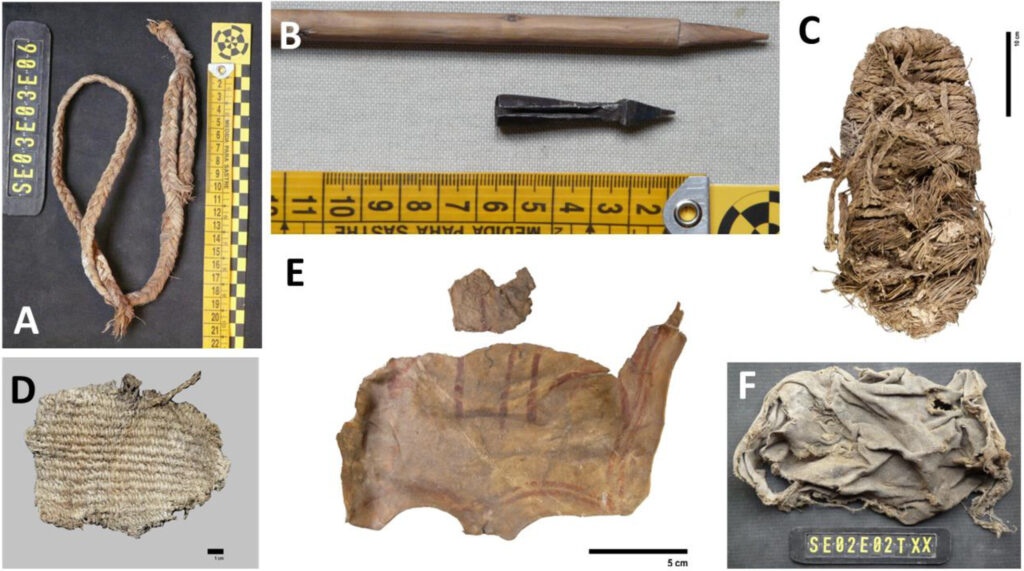
The original study figure shows the complete esparto-grass sandal alongside other handcrafted materials recovered from ancient bearded vulture nests.
View original source → Preview from the Vulture Conservation Foundation source page. The original photograph remains on its source.Why does the study say “674 years BP” rather than simply “674 years old”?
Radiocarbon dates commonly use BP, or Before Present, with 1950 as the conventional reference year. A result of 674 years BP therefore does not mean 674 years before the current year. It is a radiocarbon age referenced to 1950. The study itself gives the archaeological interpretation as the late 13th century.
This distinction matters because “650-year-old sandal” is a convenient media description, while the scientific result is more precise: 674 ± 22 radiocarbon years BP, corresponding to the late 13th century.
How Could a Vulture Nest Preserve a Human Sandal?
The answer begins with where bearded vultures build their nests.
Bearded vultures typically use protected nesting locations such as cliff caves, rocky shelters, and ledges. The research team noted that these sites have microclimatic conditions that help preserve both the bones delivered to the nest as food and the materials used to build the nest.
Over time, generations of birds can return to established nesting sites and add new material. The result can be a layered accumulation of biological and human-made remains.
.jpg "Ancient bearded vulture nest examined by researchers")
Photo: Francesco Veronesi.
Source: Wikimedia Commons file page.
License: Creative Commons Attribution-ShareAlike 2.0 (CC BY-SA 2.0).
In the Spanish nests, this behavior effectively created a natural archive.
The dry, protected conditions helped prevent materials such as grass, leather, cloth, and other objects from disappearing as quickly as they would in more exposed environments. The researchers describe these protected nesting locations as having relatively stable temperatures and low humidity, conditions that helped the accumulated material remain in good condition. That is why a type of rough footwear that was normally short-lived in everyday use could survive inside a nest for centuries.
Did the Vultures Deliberately Collect Human Artifacts?
Not necessarily.
The study shows that human-made materials ended up in the nests, but it does not establish that the birds understood the objects as human artifacts or deliberately searched for archaeological material.
The researchers suggest that the objects were probably gathered from the surrounding environment and used as nest-building material. A crossbow bolt provides a good example of why individual objects need to be interpreted carefully.
The bolt may have been used as a substitute for a branch, or the bird may have picked it up together with the remains of a dead prey animal that had been delivered to the nest.
That means it would be misleading to describe the vultures as intentionally collecting “treasures” in the human sense. Their behavior was more straightforward: they transported material to a nesting site, and some of that material happened to be human-made.
Other Human Objects Tell a Larger Story
The sandal was not an isolated curiosity.
The nests also contained a fragment of basketry that was dated to 151 ± 22 years BP, corresponding to the late 18th century. Another layer of the same nest as the sandal contained a piece of sheep leather with red pigment that was dated to 651 ± 22 years BP.
Researchers also documented an esparto-grass slingshot and the crossbow bolt with its wooden shaft. Another striking find was a fragment of sheep leather with red lines drawn in ochre. The leather was dated to 651 ± 22 years Before Present. These objects show that the sandal was only one part of a much larger collection of human-made material preserved in the nests.
Together, these objects demonstrate that the nests were not preserving one single moment in history. Different materials accumulated at different times, creating layers that could contain evidence from widely separated periods.
That is what makes the discovery scientifically valuable. The objects are not interesting only because they are old. They can also provide information about the materials people used, the objects present in the landscape, and the relationship between human activity and wildlife habitat.
The Nests Also Preserve Evidence About Wildlife
The human artifacts are only one part of the story.
The 2,117 bone remains found in the nests can provide information about the vultures’ feeding ecology. Bearded vultures are highly specialized scavenging birds that carry bones and other animal remains to their nesting sites, where accumulated material can remain preserved.
Because the nests were examined using stratigraphic methods, researchers can study their contents as layers rather than as a random modern collection.
This can potentially reveal information about the animals living in the surrounding landscape at different points in time.
In other words, the same nest can preserve two kinds of history at once: evidence of what the vultures were eating and evidence of what was present in the human landscape around them.
Why Bearded Vulture Nests Can Act Like Natural Archives
The researchers describe the species as an accumulator because its nesting behavior can concentrate and preserve material over long periods.
This is important because most biological evidence disappears quickly. Cloth rots, plant fibers break down, leather deteriorates, and many other materials are scattered or destroyed by weather.
A protected cave is different.
When a bird repeatedly uses a sheltered nesting site, the material it brings can remain protected from many of the processes that normally erase traces of the past.
The nest therefore becomes more than a place where chicks are raised. It can become a layered record of the environment around it.
In one of the study's most revealing comparisons, the initial layers of one examined nest were dated about five centuries earlier than those of another nearby nest. The finding shows how different nesting sites can preserve very different spans of local history.
The Bearded Vulture Had Already Disappeared From Southern Spain
There is another reason the discovery is unusual: the birds that created these historical archives are no longer present in southern Spain in the way they once were.
The study notes that bearded vultures became regionally extinct in parts of southern Spain roughly 70 to 130 years ago, depending on the location.
Yet their old nests remained in the landscape.
That created an unusual scientific situation. Researchers could study structures built and reused by a species that had already disappeared locally, allowing the abandoned nests to preserve evidence of earlier ecological conditions.
This does not mean the species is extinct globally. The bearded vulture still survives in other parts of its range; the study itself describes populations elsewhere and discusses the species in the context of European recovery and conservation.
What the Sandal Reveals About Human History
The sandal is particularly valuable because it is a manufactured object rather than an ordinary natural material.
Its construction reflects the use of plant fibers to make practical footwear. The fact that it survived in a vulture nest gives researchers an unusual piece of evidence that would otherwise have been much more vulnerable to decay.
The discovery also demonstrates why archaeology does not always happen in places traditionally labeled archaeological sites.
A bird nest can become part of the archaeological record when animals repeatedly move material through the landscape and deposit it in a protected location.
That creates an unusual overlap between ecology, archaeology, taphonomy, and environmental history.
What Scientists Can Learn From These Ancient Nests
The researchers argue that studying old bearded vulture nests can provide information about both feeding ecology and historical ethnographic and biocultural conditions.
That means future studies could potentially use these accumulations to ask questions about:
- Which animals lived in the surrounding landscape in earlier periods?
- What kinds of materials were available to the vultures?
- How did human activity change around long-used nesting areas?
- What kinds of plant fibers, leather, cloth, or tools were present in the landscape?
- How long did particular nesting sites remain in use?
The researchers' approach also shows the value of collaboration. The project brought together wildlife ecology and archaeological methods to interpret material that might otherwise have been dismissed as ordinary nest debris.
Why This Story Matters
The sandal is fascinating because it connects two worlds that are rarely discussed together.
One is the world of wildlife: a large mountain bird repeatedly returning to a protected nesting site and carrying material back to its nest.
The other is the human past: handmade footwear, plant fibers, leather, cloth, basketry, and tools that once belonged to people living in the same broader landscape.
Neither side was intentionally creating a historical record. The people who made the objects were making practical items, and the vultures were simply using available material. The archive emerged because the two histories became physically connected inside protected nesting sites.
That is what makes this discovery so valuable. The bearded vultures did not set out to preserve human history. Their ordinary behavior did it accidentally.
Questions About the 650-Year-Old Sandal
Was the sandal really 650 years old?
The underlying scientific result was 674 ± 22 radiocarbon years BP. The researchers interpreted the date as belonging to the late 13th century. The “650-year-old” wording is a rounded media description, not the exact laboratory result.
Was the sandal made by humans?
Yes. It was a manufactured piece of footwear made from esparto grass cord and was classified among the human-made materials found in the nest.
Did the vulture steal the sandal from a person?
There is no evidence establishing that. The researchers suggest that human-made objects were probably collected from the surrounding environment for nest building. The exact route by which individual objects entered the nests cannot always be determined.
Why did the sandal survive for so long?
The nests were located in protected rocky and cave environments with microclimatic conditions that helped preserve organic materials. Those conditions limited the deterioration that would normally destroy grass, leather, and cloth over long periods.
Were the vultures using the same nests for centuries?
The study documents the long-term reuse of bearded vulture nesting sites and found layers representing different periods. The researchers describe the nests as accumulators of material over long timescales.
Takeaway
A sandal may seem like an unlikely archaeological discovery for a wildlife study, but the bearded vulture's nesting behavior helps explain why it ended up there.
Researchers examining 12 abandoned nests in southern Spain recovered 2,483 remains, including 226 human-made materials. Among them was a complete esparto-grass sandal radiocarbon-dated to 674 ± 22 years BP and interpreted as dating to the late 13th century.
The discovery shows how animals can unintentionally preserve evidence of the past. A nest built for raising young became a layered record containing clues about wildlife, materials, and human activity across centuries.
The remarkable part is not that the vulture knew the sandal was valuable. It did not. The remarkable part is that an ordinary piece of nesting behavior helped preserve something that would otherwise have been far more likely to disappear.
More From The Pader
Read Next
Amazing Animal Stories: Remarkable Animals and the Stories Behind Them
Rare & Unusual Animals: Strange, Elusive, and Extraordinary Creatures
Sources and Further Reading
PubMed Central — Full text of the 2025 Ecology study.
University of Granada — Institutional repository record for the study.
Ecological Society of America — The bearded vulture, an unusual “archaeologist.”
Smithsonian Magazine — Reporting on the artifacts recovered from the nests.
U.S. National Park Service — Explanation of radiocarbon “Before Present” dating.
Status: FACT-CHECKED
The central discovery, study location, number of nests examined, total remains recovered, number of anthropogenic remains, sandal material, and radiocarbon result were checked against the 2025 peer-reviewed Ecology study by Margalida and colleagues. The study reports 2,483 remains from 12 nests, including 226 anthropogenic remains, and dates the complete esparto-grass sandal to 674 ± 22 years Before Present, corresponding to the late 13th century.
The article deliberately distinguishes the scientific radiocarbon result from the simplified “650-year-old” media description. It also avoids claiming that the vultures intentionally collected valuable human artifacts or that every object entered the nests in the same way. The researchers identify likely nest-building use for the anthropogenic material, while the exact origin of individual objects can be uncertain.
Radiocarbon “BP” uses 1950 as its conventional reference year, so the laboratory result should not be read as simply 674 years before the current calendar year.
The Pader presents wildlife and science information using credible sources and accessible language. Scientific information may be updated as new research emerges.