
Amazing Animal Adaptations: How Animals Survive Extreme Environments
Life on Earth exists in environments that can be incredibly difficult to survive. Animals live in freezing polar regions, scorching deserts, deep oceans, high mountains, dark caves, and habitats where food or water can be scarce.
Yet these environments are not simply places where animals somehow endure hardship. Over generations, species have evolved traits and behaviors that make them better suited to the conditions around them.
These remarkable solutions are called adaptations. They can involve an animal's body, behavior, or internal biology—and they help animals find food, conserve water, regulate temperature, avoid predators, reproduce, and survive in their particular habitats.
In this guide, we look at some of the most fascinating animal adaptations and the science behind how they help wildlife survive extreme environments.
 |
| Amazing Animal Adaptations — A polar bear, Arctic fox, camel, electric eel, frog, and tardigrade represent the remarkable adaptations that help animals survive extreme environments around the world. AI-generated illustration created for The Pader. |
What Are Animal Adaptations?
An adaptation is a physical or behavioral feature that helps an animal survive in its environment. The Smithsonian National Museum of Natural History explains that adaptations can involve characteristics on an animal's body or things an animal does that improve its chances of finding food, water, shelter, mates, or avoiding danger. Smithsonian National Museum of Natural History
Adaptations can be grouped broadly into three types:
- Physical or structural adaptations: features such as thick fur, large paws, specialized teeth, camouflage, or webbed feet.
- Behavioral adaptations: actions such as migration, hunting at night, storing food, huddling, or seeking shelter underground.
- Physiological adaptations: internal processes that help an animal function, such as conserving water, slowing metabolism, or controlling blood flow.
Importantly, animals do not consciously decide to develop an adaptation because an environment is difficult. Adaptations arise through evolutionary processes over generations. When a heritable trait gives individuals an advantage in a particular environment, those individuals may be more likely to survive and reproduce.
Why Do Animals Need Adaptations?
Every habitat presents its own challenges. In the Arctic, an animal may have to deal with freezing temperatures, ice, strong winds, and seasonal changes in food availability. In a desert, the biggest problems may be heat and limited water.
In other environments, the challenge may be something completely different. Animals in mountains may encounter thin air and steep terrain. Cave animals may live with little or no sunlight. Marine animals face the physical demands of moving through water, while deep-sea species must cope with darkness, cold, and enormous pressure.
The solution is rarely just one adaptation. Animals usually have a combination of traits and behaviors that work together.
How Do Animals Survive Extreme Cold?
Cold environments create a major problem: heat can be lost from the body faster than it can be produced. Animals living in polar and subpolar habitats have evolved several ways to reduce this heat loss.
Polar bears are one of the clearest examples. The U.S. National Park Service reports that polar bears have a thick layer of blubber beneath their skin, dense underfur, and an outer layer of guard hairs that helps keep the underfur dry. They also have black skin and a thick white coat that helps with camouflage and water resistance. Their large paws help them swim efficiently. U.S. National Park Service
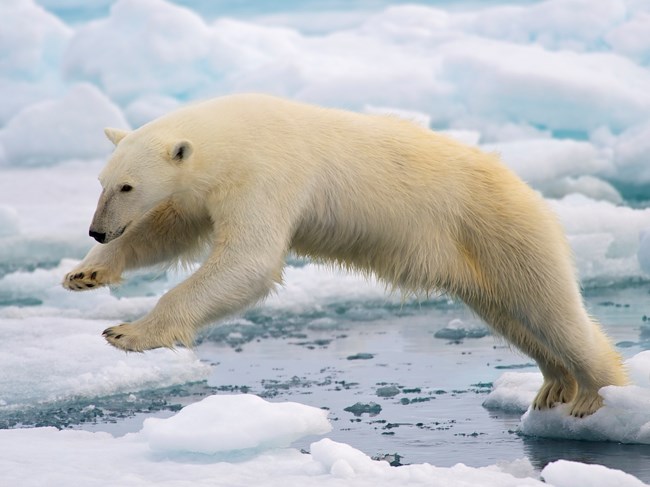
Other Arctic animals use different combinations of insulation, camouflage, body shape, and behavior. The National Park Service notes that Arctic wildlife may rely on extra insulation, seasonal color changes, specialized feet, and migration to cope with the environment. National Park Service — Wildlife of the Arctic
How Do Animals Survive Extreme Heat?
Deserts can be just as challenging as polar environments, but for very different reasons. Animals must avoid overheating while also dealing with limited access to water.
One strategy is to avoid the hottest part of the day. Many desert animals are most active during cooler periods such as dawn, dusk, or nighttime. Others retreat into burrows where temperatures can be more stable.
Camels are a famous example of desert adaptation. Their bodies are specialized for environments where heat and water scarcity are major challenges. Their nostrils can help recover moisture as they breathe, while their physiology allows them to tolerate substantial changes in body water without immediately becoming critically dehydrated. National Geographic
But camels are not the only desert specialists. The Smithsonian's National Zoo notes that sand cats can survive for long periods without drinking water because much of their hydration comes from the prey they eat. Their furry footpads also protect them from hot sand, while their large paws help with digging and moving across loose desert surfaces. Smithsonian's National Zoo

How Do Animals Survive When Water Is Scarce?
Water conservation is one of the most important survival problems in dry environments. Some animals obtain most of their water from food rather than drinking directly.
Others reduce water loss through behavior. They may stay underground during the hottest hours, become active at night, or choose sheltered areas that reduce exposure to heat.
These strategies show why adaptation is more than simply having a special body part. A physical trait and a behavior can work together. An animal might have a body designed to conserve water while also changing its daily activity pattern to avoid the hottest conditions.
How Do Animals Survive With Little Food?
Extreme environments often provide food only at certain times of the year. Animals may respond by storing energy, storing food, migrating, changing their diet, or reducing their energy requirements.
For example, the National Park Service describes how Arctic brown bears reduce activity and energy use during winter denning, relying on stored body fat while food is difficult to obtain. National Park Service
Some animals also become opportunistic feeders. Arctic foxes, for instance, can eat a varied diet and may store food when it is abundant. When food is scarce, they may follow larger predators and feed on leftovers. National Park Service — Alaskan Animal Adaptations
Why Do Some Animals Change Color?
Camouflage can be an important survival advantage. If an animal blends into its surroundings, it may be harder for predators to detect it—and it may also be easier for the animal to approach prey.
Arctic foxes provide a striking example. According to the National Park Service, their fur can become white during winter, helping them blend into snowy surroundings, while their coat changes to a brownish-gray color as summer approaches and the tundra becomes snow-free. National Park Service

How Do Animals Survive in Darkness?
Not every extreme environment is defined by temperature. Some animals live where sunlight is scarce or completely absent.
Cave animals, for example, may experience extremely low light and limited oxygen. NOAA Ocean Exploration explains that animals living permanently in marine caves can show reduced pigmentation, smaller or absent eyes, enhanced non-visual sensory systems, and lower metabolic demands. NOAA Ocean Exploration
In darkness, an animal cannot depend on vision in the same way as a surface-dwelling species. Natural selection can therefore favor other ways of detecting food, predators, and environmental signals.
How Do Animals Survive in Extreme Mountains?
High-altitude environments bring their own combination of challenges. Temperatures can be low, food can be limited, and oxygen availability decreases as elevation increases.
Mountain animals may have specialized respiratory, circulatory, muscular, or behavioral traits that help them cope. Some also have physical structures that improve balance and movement on steep terrain.
National Geographic has documented how mountain species such as snow leopards, mountain goats, and mountain hares have adaptations suited to cold, steep, and low-oxygen environments. National Geographic
Can Animals Survive Being Frozen?
Some of the most surprising adaptations occur in animals that can tolerate conditions that would normally destroy living cells.
Tardigrades, sometimes called water bears, are tiny animals famous for their ability to survive severe environmental stress. When conditions become extremely dry, they can enter a dormant state in which their metabolism falls dramatically. This state allows them to endure conditions that would be fatal to active animals.
Research and experiments have shown that tardigrades can tolerate extreme dehydration, very low temperatures, radiation, and even exposure to the vacuum of space under specific experimental conditions. Their remarkable resilience makes them one of the most famous examples of extreme biological survival.
However, this does not mean tardigrades are literally indestructible. Their survival depends on particular species, conditions, and the state of the animal. The famous “indestructible” reputation should therefore be treated as shorthand for extraordinary resilience, not invulnerability.
Why Are Animal Adaptations So Different?
There is no single best adaptation for survival. A trait that is useful in one habitat may be useless—or even harmful—in another.
Consider the contrast between a polar bear and a desert animal. A polar bear benefits from insulation that slows heat loss, while a desert animal may benefit from mechanisms that release heat and conserve water.
The same principle applies to behavior. Migration can be useful when food or temperature changes seasonally. Staying underground can be useful in a desert. Huddling can help some animals conserve heat. Hunting at night can reduce exposure to daytime heat.
Adaptation is therefore about matching biology and behavior to the environment.
Adaptations Can Work Together
The most impressive survival strategies are often combinations of many adaptations rather than one extraordinary feature.
A polar bear, for example, does not rely only on fur. It combines insulation, body fat, specialized paws, camouflage, a carnivorous diet, and behavioral strategies suited to life around sea ice.
An Arctic fox combines seasonal camouflage with sensitive hearing, flexible feeding behavior, food storage, and the ability to exploit leftovers from larger predators.
A desert animal may combine heat avoidance, water conservation, specialized feet, burrowing, nocturnal activity, and a diet that provides much of its required moisture.
When these traits work together, an animal becomes highly specialized for its ecological niche.
What Animal Adaptations Teach Us About Evolution
Animal adaptations are also evidence of the long-term relationship between organisms and their environments. Species do not evolve toward perfection. Instead, populations change over generations, and traits that improve survival and reproduction in a particular environment can become more common.
This also explains why adaptation has limits. A species may be highly specialized for one environment but vulnerable when that environment changes too quickly.
Climate change, habitat loss, pollution, and other human-driven changes can therefore create new challenges that some species may not be able to overcome quickly enough.
Why Animal Adaptations Matter
Studying animal adaptations helps scientists understand how life functions across Earth's ecosystems. It also gives us clues about how species may respond to environmental change.
From the insulating body of a polar bear to the water-saving strategies of desert animals and the extraordinary resilience of tardigrades, adaptations show how diverse the solutions to survival can be.
The deeper lesson is simple: animals survive not because their environments are easy, but because their biology and behavior have been shaped to meet the challenges of the places they call home.
Conclusion
Extreme environments may look impossible to humans, but they are home to animals with remarkable survival strategies.
Some rely on thick insulation. Others conserve nearly every drop of water. Some change color with the seasons, retreat underground, migrate, store food, slow their metabolism, or use highly specialized senses.
These adaptations are more than fascinating animal facts. They are examples of evolution in action and reminders of how diverse life on Earth can be.
More From The Pader
How Ocean Animals Survive: Amazing Ocean Adaptations
How Deep-Sea Animals Survive in Darkness and Extreme Pressure
How Penguins Stay Warm in Freezing Water: The Science Behind Their Survival
How Sharks Detect Their Prey: The Amazing Senses That Help Them Hunt
How Seals Hold Their Breath for So Long: The Science Behind Their Underwater Survival
Sources and Further Reading
Smithsonian National Museum of Natural History — Explore Animal Adaptations
U.S. National Park Service — Polar Bear
U.S. National Park Service — Alaskan Animal Adaptations
U.S. National Park Service — Wildlife of the Arctic
Smithsonian's National Zoo — Sand Cat Adaptations
NOAA Ocean Exploration — Cave Animal Adaptations
National Geographic — Animals That Handle Extreme Heat
National Geographic — Animals in Extreme Mountain Conditions
Fact-check
This article is based on information from the Smithsonian National Museum of Natural History, Smithsonian's National Zoo and Conservation Biology Institute, the U.S. National Park Service, NOAA Ocean Exploration, and National Geographic. Claims about specific animal adaptations were checked against the cited sources. The article uses “adaptation” in its evolutionary biology sense and does not imply that individual animals consciously develop traits because they need them.
Written for The Pader by Sahim Ader.
Editorial note: This article is part of The Pader's Animal Adaptations series, which explores the remarkable physical, behavioral, and physiological traits that help wildlife survive in different environments. It is intended for educational and informational purposes.
0 comments:
Post a Comment