How Bats Use Echolocation to Hunt and Navigate in the Dark
Quick Answer: Bats use echolocation by producing high-frequency sounds and listening to the echoes that return after bouncing off objects. The timing, frequency, direction and other properties of those echoes provide information about their surroundings, helping many bats locate prey, avoid obstacles and navigate while flying in darkness.
Introduction
For many bats, darkness does not mean losing the ability to find their way. Instead, echolocating species use one of nature's most sophisticated biological sensing systems: echolocation.
By producing high-frequency calls and analyzing the echoes that return, bats can gather information about objects around them. This can help them detect obstacles, locate prey and adjust their flight even when visibility is extremely limited.
Echolocation is especially important for many insect-eating bats, whose nighttime hunting can require them to track small and rapidly moving prey through open air or cluttered habitats.
 |
| A bat uses ultrasonic calls and returning echoes to detect objects, navigate through darkness, and locate prey. AI-generated illustration for educational purposes. |
What Is Echolocation?
Echolocation is a biological sensing system based on sound. A bat produces an acoustic signal that travels through the surrounding air. When the sound encounters an object, part of the acoustic energy is reflected back toward the bat.
The bat can then analyze characteristics of the returning echo. The time between the outgoing call and the returning echo provides information about distance, while other features of the echo can provide information about the target's position, movement and acoustic properties.
Research on echolocating bats shows that they actively control features of their calls, including duration, intensity, frequency, directionality and timing. This allows the sensory system to adapt to different hunting and navigation situations.
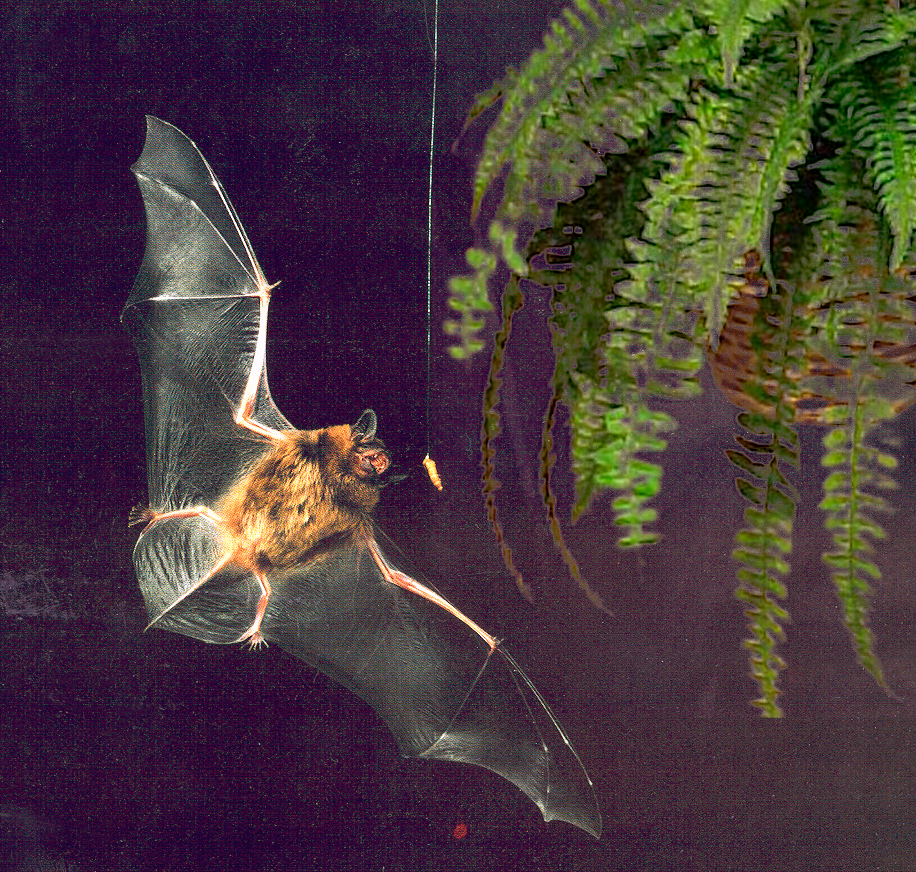
How Bats Use Echolocation to Navigate
When a bat flies through darkness, echoes can provide information about objects that may be difficult to distinguish visually. Trees, branches, vegetation, walls and other surfaces can all produce echoes that help a bat detect potential obstacles.
Bats do not necessarily use exactly the same call throughout a flight. They can adjust their acoustic signals depending on their environment and the task they are performing.
This flexibility is especially useful because an open area and a dense forest create very different acoustic conditions. A bat flying through vegetation must separate useful echoes from many nearby surfaces, while a bat flying through open air may need to detect and track a small insect at greater distances.

How Echolocation Helps Bats Hunt
For insect-hunting bats, echolocation is closely connected to the stages of a hunt. Researchers commonly describe aerial insect hunting in phases that include searching for targets, approaching selected prey and making the final interception.
During the search phase, calls are generally spaced farther apart. Once a bat detects a target and begins approaching it, the call rate can increase while the calls become shorter.
During the final stage of an attack, many insect-hunting bats produce a rapid sequence of calls known as a feeding buzz or terminal buzz.
This rapid increase in call repetition allows the bat to gather acoustic information at a much higher rate while it closes in on moving prey.
Why Do Bats Increase Their Call Rate Near Prey?
A moving insect can change position quickly, so information that was accurate a moment ago can soon become outdated.
By increasing the repetition rate of echolocation calls during the approach, the bat can obtain more frequent acoustic updates about the target. This allows its sensory system and flight behavior to work together during the final part of the pursuit.
A review published in the Journal of Experimental Biology describes search, approach and terminal-buzz phases in insect-hunting bats. In the species and situations reviewed, call rates can rise dramatically as the bat moves from searching to the final attack.

What Is the Feeding Buzz?
The feeding buzz is the rapid sequence of echolocation calls produced by many insectivorous bats immediately before an attempted prey capture.
It is not simply a louder version of an ordinary echolocation call. Instead, the bat changes the timing and other characteristics of its calls as it gets closer to the target.
Research on bats has shown that the final buzz can provide an extremely high rate of acoustic sampling. This is useful when a bat has only fractions of a second to adjust its flight and intercept a moving insect.
How Bats Detect Small Prey
Detecting a small insect with sound is not as simple as producing the loudest possible call. The acoustic properties of the signal matter.
Higher frequencies have shorter wavelengths and can provide useful information about relatively small targets. However, high-frequency sound is also strongly attenuated by the atmosphere, limiting how effectively it can travel through air.
This creates a biological trade-off. The bat's echolocation system must produce signals appropriate for the target, habitat and distance at which detection is required.
Different bat species have therefore evolved different echolocation strategies that reflect their body size, hearing abilities and foraging environments.
Bats Can Change Their Echolocation Strategy
Echolocation is not a simple sonar system that operates identically throughout a bat's entire flight.
Bats can modify several properties of their calls, including frequency, duration, intensity, directionality and repetition rate. These changes allow the same sensory system to perform different tasks.
A bat searching for prey may use a different acoustic strategy from one making a final approach toward an insect. The structure of the surrounding habitat can also influence how the bat adjusts its signals.
This is why researchers describe bat echolocation as a dynamic system in which sound production, hearing, sensory processing and movement are closely coordinated.
How Bats Find Their Way Around Obstacles
Echolocation can also help bats respond to objects in their flight path.
When a bat approaches an obstacle, the echoes returning from that object can change as the distance decreases. By producing calls more frequently and analyzing the returning signals, the bat can obtain increasingly detailed information about its surroundings.
Research on echolocating bats has shown that bats can use acoustic landmarks and changes in echo patterns for spatial orientation. This allows echolocation to function as more than a prey-detection system.
Some Bats Can Find Motionless Prey on Leaves
One particularly unusual example comes from the common big-eared bat, Micronycteris microtis.
Researchers discovered that this species can detect insects resting motionless on leaves by using the leaf itself as part of the acoustic environment. Instead of relying only on a direct echo from the insect, the bat can approach the leaf from an angle that allows sound to interact with the leaf and return information about the prey.
The strategy was described as using leaves as acoustic mirrors. It is a striking example of how bats can exploit the physical properties of their surroundings to solve difficult sensory problems.
The finding also demonstrates why echolocation should not be thought of as simply “hearing an object's echo.” Bats can use complex patterns of sound reflection to extract information from their environment.
Echolocation and the Bat's Other Senses
Echolocation does not mean that bats completely stop using their other senses.
Bats also possess vision, smell, touch and highly sensitive hearing. The importance of each sense varies among species and situations.
Researchers studying echolocating bats emphasize that successful hunting involves multiple sensory and motor processes. Echolocation provides acoustic information, while the bat's nervous system integrates that information with its movement and other available sensory cues.
Not All Bats Use Echolocation in Exactly the Same Way
It is important not to treat all bats as though they have identical sensory systems.
Echolocating bats differ in their call frequencies, signal structures, hearing abilities, hunting strategies and habitats. Some specialize in catching insects in open air, while others forage close to vegetation or use different strategies for locating prey.
Some bat species also produce relatively low-intensity calls compared with other echolocating bats. Their signals can reflect differences in foraging strategy and the environments in which they hunt.
For this reason, statements that describe echolocation as one identical system shared by every bat can oversimplify the biology.
Why Echolocation Is Such an Effective Survival Adaptation
Echolocation gives bats access to information that would otherwise be difficult to obtain in darkness. Instead of depending entirely on reflected light, an echolocating bat can use reflected sound to gather information about objects around it.
The system is particularly effective because it is adjustable. Bats can modify their calls depending on what they are trying to detect and the environment in which they are flying.
From a biological perspective, echolocation is therefore more than simply “seeing with sound.” It is a coordinated system involving sound production, hearing, sensory processing and flight control.
Conclusion
Bats use echolocation by sending out high-frequency sounds and analyzing the echoes that return from objects in their environment. The information contained in those echoes can help them detect prey, avoid obstacles and maintain spatial awareness while flying at night.
The remarkable part is that the system is constantly changing. As a bat searches, approaches prey and prepares to strike, its calls can change in timing and structure to provide increasingly rapid information.
Echolocation shows how evolution can connect an animal's senses, behavior and movement into one highly coordinated system—allowing bats to hunt and navigate through environments where vision alone may not provide enough information.
More From The Pader
How Animals Sense the World: The Extraordinary Senses That Help Animals Survive
How Deep-Sea Animals Survive in Darkness and Extreme Pressure
How Himalayan Animals Survive Extreme Altitudes: The Science Behind Their Survival
How Yaks Survive in the High Himalayas: The Science Behind Their Extreme Adaptations
How Snow Leopards Survive in the High Himalayas: The Science Behind Their Adaptations
Sources and Further Reading
Hearing and Hunting in Red Bats — Journal of Experimental Biology
Bats Use Leaves as Mirrors to Locate and Catch Their Prey — Smithsonian Institution
Test Your Knowledge
1. What is the basic principle behind bat echolocation?
A. Bats create light with their eyes
B. Bats send out sounds and analyze returning echoes
C. Bats sense Earth's magnetic field through their wings
D. Bats detect prey through body heat alone
2. What can happen to echolocation call rate when an insect-hunting bat approaches prey?
A. It always stops completely
B. It remains exactly the same
C. It can increase substantially
D. It switches entirely to smell
3. What is a feeding buzz?
A. A social call used only between bats
B. A rapid sequence of echolocation calls produced during the final approach to prey
C. A sound produced by insects to attract bats
D. A sound bats make only when sleeping
4. Can the surrounding environment contribute to a bat's ability to locate prey?
A. No, only the prey itself matters
B. Yes, environmental surfaces can affect the returning echoes
C. Only underwater bats can use environmental echoes
D. Only fruit-eating bats can do this
Answers
1. B — Echolocation works by producing sounds and analyzing the echoes that return after interacting with objects.
2. C — During prey pursuit, many insect-hunting bats increase their call repetition rate, particularly during the approach and final attack.
3. B — A feeding buzz is the rapid sequence of calls associated with the final stage of prey capture.
4. B — Environmental surfaces can shape returning echoes, and research has shown that some bats can exploit these acoustic reflections when locating prey.
Status: FACT-CHECKED
This article was reviewed against peer-reviewed research on bat echolocation, including studies covering acoustic scene reconstruction, call timing, frequency, intensity, directionality, prey tracking, obstacle orientation and feeding buzzes. Research on the common big-eared bat's use of leaves as acoustic mirrors was also reviewed. Because echolocation varies considerably among bat species, the article describes documented general patterns and identifies species-specific examples rather than treating every bat as having an identical sensory system.
The Pader presents wildlife and science information using credible sources and accessible language. Scientific information may be updated as new research emerges.