
How Narwhals Survive Beneath Arctic Ice: The Science Behind Their Extreme Adaptations
Quick Answer: Narwhals survive beneath Arctic ice through a combination of thick blubber, deep-diving physiology, oxygen-rich muscles, streamlined bodies, and specialized behavior. Because they are air-breathing mammals, they must also remain connected to openings in the sea ice. Their ability to dive deeply, conserve oxygen, and navigate an environment dominated by ice allows them to live where few other large marine mammals can.
Introduction
The Arctic is one of the most demanding environments on Earth, but narwhals spend much of their lives in exactly that setting.
These toothed whales live in Arctic waters where sea ice can cover enormous areas of the ocean. During winter, narwhals can remain offshore among dense pack ice, diving into deep water to feed and returning to openings in the ice to breathe.
Surviving there requires more than simply tolerating cold water. Narwhals have evolved a combination of insulation, diving physiology, oxygen storage, body shape and behavior that allows them to function in an environment where access to the surface can be limited.
Their famous tusk is also unusual, but it should not be treated as the main reason narwhals survive Arctic ice. Their survival depends on a much broader collection of adaptations working together.
FAST FACTS
- Species: Monodon monoceros
- Habitat: Arctic Ocean
- Winter environment: Dense sea ice and deep offshore waters
- Deep-diving ability: More than 1,800 meters has been recorded
- Main winter challenge: Finding and reaching openings in the sea ice to breathe
- Major insulation: A thick layer of blubber
- Important diving adaptation: High muscle myoglobin and a large proportion of slow-twitch oxidative muscle fibers
- Distinctive feature: A long, spiraled tooth, or tusk, especially common in males
 |
| Narwhals glide beneath Arctic sea ice, using specialized adaptations that help them survive extreme cold, deep dives, and a habitat where access to breathing openings can be critical. (Cover image: AI-generated wildlife illustration created for editorial and educational purposes.) |
Why Is Arctic Sea Ice So Difficult for a Whale?
Narwhals face an unusual problem that most marine mammals do not experience to the same degree: they cannot simply surface anywhere they want.
They are air-breathing mammals, so they must periodically reach the surface. In heavily ice-covered areas, however, much of the ocean surface can be sealed beneath frozen seawater.
That means a narwhal swimming beneath the ice has to remain within an environment where suitable openings are available.
Research on narwhal winter habitat has documented their dependence on leads and cracks in the sea ice. These openings provide access to atmospheric oxygen in an otherwise ice-covered environment.
Unlike some Arctic animals that can create or maintain their own openings, narwhals depend on existing openings in the ice. Rapid freezing or changes in the ice can therefore become a serious hazard.

They Are Built for Extremely Cold Water
One of the most important adaptations is something narwhals share with other Arctic marine mammals: thick blubber.
Blubber is a specialized layer of fatty tissue beneath the skin. It provides insulation by slowing the transfer of heat from the warmer body to the surrounding cold water.
Narwhals maintain particularly strong adaptations for living in cold Arctic water. Research has found that they possess a thick blubber layer and a narrow thermal niche, meaning they are strongly associated with cold water conditions.
This insulation is essential because water conducts heat much more efficiently than air. A marine mammal swimming through near-freezing seawater can lose body heat rapidly without effective insulation.
Narwhal blubber does more than keep the animal warm. It is also an energy reserve. That combination is especially useful for a marine mammal living in a cold environment where feeding opportunities can vary seasonally.
Why Narwhals Do Not Have a Dorsal Fin
Look at a narwhal and one feature immediately stands out when compared with many other whales: it has no dorsal fin.
The absence of a large dorsal fin is particularly useful in an Arctic environment dominated by sea ice.
A dorsal fin would extend upward toward the ice whenever a whale swam close to the underside of the frozen surface. Narwhals instead have a smooth back that allows them to move through narrow spaces beneath the ice without carrying a large upright fin.
The lack of a dorsal fin is also consistent with their extreme specialization for polar life. NOAA Fisheries identifies the absence of a dorsal fin as one of the species' characteristic physical features.
It is important not to describe the missing fin as a single-purpose adaptation that solves the entire ice problem. Narwhal survival results from many traits working together.
Their Bodies Are Built for Deep Diving
Sea ice is only one part of the narwhal's environment. Beneath it lies deep Arctic water where narwhals search for prey.
NOAA reports that narwhals are capable of diving to more than 1,800 meters, while NOAA Fisheries describes regular deep dives in the species' feeding behavior.
At such depths, pressure increases dramatically. A narwhal's body must therefore cope with pressure while continuing to swim and conserve oxygen.
The species' streamlined body and specialized diving physiology allow it to spend substantial amounts of time underwater instead of repeatedly returning to the surface.
Their Muscles Can Store Large Amounts of Oxygen
One of the most important adaptations for a diving mammal is the ability to carry oxygen inside its body.
Narwhals have unusually high concentrations of myoglobin in their muscles. Myoglobin is an oxygen-binding protein that helps store oxygen within muscle tissue.
A 2011 study found that narwhal locomotor muscle contained very high levels of myoglobin and that much of the muscle was composed of slow-twitch oxidative fibers.
These muscle fibers are associated with sustained, efficient activity rather than short bursts of high-speed movement.
For a narwhal, that fits its lifestyle. It does not need to sprint continuously beneath the ice. Instead, its physiology is highly specialized for endurance swimming and long dives.
Slow-Twitch Muscles Help Them Dive Efficiently
The 2011 physiological study found that approximately 86.8 percent of the sampled longissimus dorsi muscle fibers were slow-twitch oxidative fibers, with some variation among individuals.
Slow-twitch oxidative fibers are well suited to sustained aerobic activity because they can use oxygen efficiently over longer periods.
That does not mean narwhals never swim quickly. Rather, their muscle structure indicates a strong specialization toward endurance.
This is important beneath Arctic ice because every trip between feeding areas and breathing openings involves an energy cost. Efficient movement can help a narwhal conserve the oxygen stored in its body.
They Must Plan Their Movement Around the Ice
A narwhal living beneath sea ice cannot simply treat the ocean above it as an unrestricted surface.
The availability of openings determines where an air-breathing whale can safely surface. Research has therefore described the distribution of open water as a major factor shaping narwhal habitat use during winter.
In one study of narwhal exercise physiology, researchers calculated that the maximum aerobic swimming distance between breathing holes was less than 1,450 meters.
That does not mean every narwhal must travel exactly that distance between every breath. Instead, it illustrates how strongly the species' physiology is tied to the spacing of openings in the ice.
When the distance between suitable breathing locations becomes too great, the animal's physiological limits become increasingly important.
Why Sea-Ice Entrapment Is So Dangerous
Narwhals are highly adapted to Arctic ice, but that does not mean more ice is always better for them.
The same environment that provides their winter habitat can also trap them.
If leads and cracks freeze rapidly, access to atmospheric oxygen can become restricted. Historical and scientific records describe large-scale narwhal mortality associated with sudden changes in sea ice that eliminate access to open water.
This is one reason researchers describe narwhals as highly specialized for their Arctic environment but also vulnerable to rapid changes in sea-ice conditions.
Their specialization gives them an advantage in the environment they evolved to use, but it can also reduce their flexibility when that environment changes unexpectedly.
They Feed Deep Beneath the Ice
Narwhals do not survive on a diet of whatever happens to be immediately available near the surface.
They are deep-water feeders and consume prey including Arctic and polar cod, Greenland halibut, squid and shrimp.
NOAA Fisheries reports that narwhals feed at or near the ocean bottom in deep water and use suction to capture prey.
During winter, feeding can become particularly important. NOAA Ocean Exploration notes that narwhals feed intensely during the winter period and much less during the ice-free summer season.
This seasonal pattern means that the winter environment beneath the ice is not simply a place where narwhals wait for spring. It can be an important feeding habitat.
Their Tusk Is a Specialized Tooth
The narwhal's famous tusk is actually a modified tooth rather than a horn.
In most males, the tooth grows outward from the upper left jaw and can reach several meters in length. Females almost never develop a tusk, although exceptions occur.
The tusk has attracted many theories about its function. Scientists have documented its role in social interactions and have also found evidence that it possesses sensory capabilities.
A 2014 study found evidence that the erupted tusk has sensory structures and can respond physiologically to changes in the surrounding water.
That makes the narwhal tusk unusual even among teeth. It is not simply a hard structure projecting from the mouth.
Can the Tusk Help Narwhals Sense Their Environment?
Research suggests that the tusk has a sensory function, although scientists are still studying the full significance of that ability.
The tusk contains networks of microscopic channels connected with sensory structures in the tooth. Experiments described in a peer-reviewed study found changes in heart rate when the external tusk surface was exposed to fresh water and high-salt solutions.
These findings demonstrate sensory capability, but they do not prove that narwhals use their tusks as a simple environmental “weather detector” or as a tool for predicting exactly when sea ice will form.
The broader function of the tusk remains an active area of research, and it may have multiple roles involving social behavior, sexual selection and sensory information.
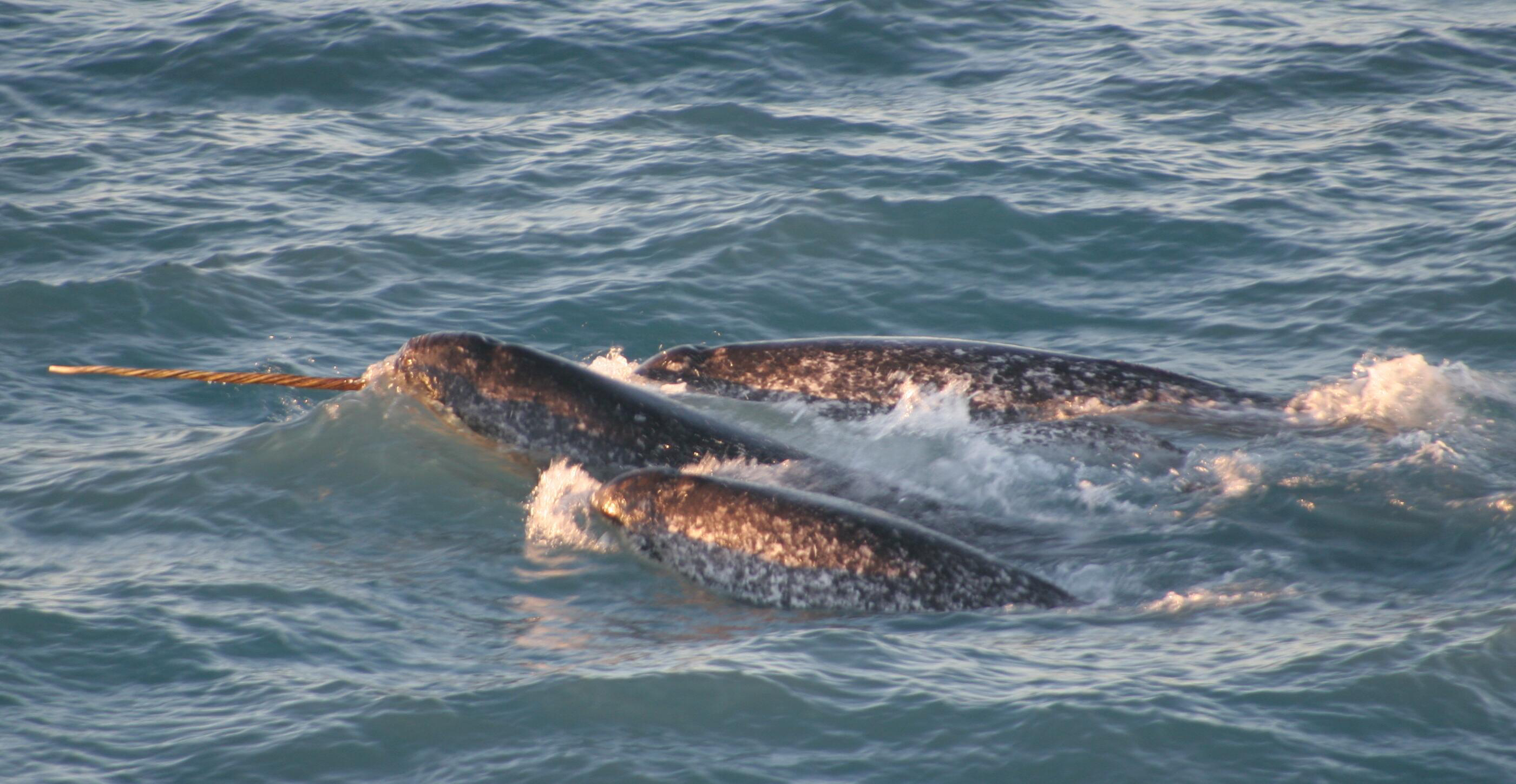
How Do Narwhals Find Their Way Under the Ice?
Moving beneath an almost continuous sheet of sea ice requires more than physical endurance.
Narwhals live in an environment where visibility can be limited by darkness, depth and ice. Their survival therefore depends on a combination of sensory information, learned behavior, movement patterns and access to suitable openings.
Scientists have also studied narwhal movement using satellite-linked tags and other animal-borne instruments. These technologies have revealed how the whales move through their difficult Arctic environment while diving and traveling beneath sea ice.
The species' remote habitat makes direct observation difficult, which is one reason modern tagging has become so important to narwhal research.
They Are Specialized for Endurance, Not Speed
Narwhals are not built like fast, highly maneuverable dolphins.
Their physiology instead points toward an endurance-based lifestyle. Their slow-twitch muscle fibers and high muscle myoglobin support sustained activity and oxygen storage.
This specialization makes sense for an animal that may need to travel beneath ice between feeding areas and breathing openings.
In other words, one of the narwhal's most important survival strategies is not simply being able to hold its breath. It is being able to use its stored oxygen efficiently while moving through a demanding environment.
The Arctic Gives Narwhals an Advantage—and a Risk
Narwhals are among the animals most strongly specialized for Arctic marine conditions.
Their thick insulation helps them tolerate cold water. Their body shape and lack of a dorsal fin suit movement beneath ice. Their muscles store large amounts of oxygen, and their diving physiology allows them to exploit deep-water prey.
But those same specializations can create vulnerabilities when the Arctic environment changes rapidly.
Research has identified sea-ice change as an important concern because narwhals depend on specific ice conditions and have limited flexibility compared with more adaptable marine mammals.
NOAA Fisheries currently lists climate change and loss of sea ice among the threats affecting narwhals.
Why Narwhals Are So Difficult to Study
Narwhals spend much of their lives in remote Arctic waters, often beneath sea ice and far from places where researchers can easily observe them.
Winter darkness adds another challenge.
As a result, scientists have historically known less about narwhals than about many other marine mammals.
Modern satellite tags, acoustic equipment, aerial surveys and other technologies have gradually revealed more about their movements, diving behavior, feeding and physiology.
Scientific research has also increasingly incorporated Inuit knowledge, which provides long-term observations of narwhal ecology and behavior in regions where conventional research is difficult.
What Makes Narwhal Survival So Remarkable?
Narwhals survive beneath Arctic ice because no single adaptation does all the work.
Their blubber protects them from cold water. Their deep-diving physiology allows them to exploit deep feeding areas. Their oxygen-rich muscles support long underwater activity. Their lack of a dorsal fin suits life beneath ice. And their behavior keeps them connected to the openings they need to breathe.
Their tusk adds another unusual biological feature, with sensory capabilities that scientists continue to investigate.
Together, these adaptations allow a large air-breathing mammal to live in one of the most ice-covered marine environments on Earth.
Conclusion
Narwhals are sometimes called the unicorns of the sea because of their extraordinary tusks, but their real biological story is even more remarkable.
They are highly specialized Arctic divers capable of moving beneath sea ice, descending to great depths and storing substantial amounts of oxygen in their bodies.
They rely on thick blubber for insulation, endurance-oriented muscles for efficient swimming and naturally occurring cracks and openings in the ice for access to air.
The same specialization that makes narwhals so successful in their traditional Arctic environment also makes them sensitive to rapid changes in sea-ice conditions.
Surviving beneath Arctic ice is therefore not about one magical adaptation. It is the result of an entire body and lifestyle shaped around cold water, deep diving, seasonal feeding and a frozen ocean surface.
Test Your Knowledge
1. Which adaptation helps narwhals stay warm in the extremely cold Arctic Ocean?
A. A thick layer of blubber
B. A layer of feathers
C. A thick layer of dry fur
D. A shell-like outer covering
2. Why is the narwhal's lack of a large dorsal fin useful in its Arctic habitat?
A. It allows the narwhal to breathe underwater
B. It helps the narwhal move beneath sea ice
C. It allows the narwhal to walk on ice
D. It prevents the narwhal from needing oxygen
3. Which feature helps narwhals remain underwater during prolonged dives?
A. Their ability to breathe underwater
B. Oxygen-rich muscles and diving adaptations
C. Their ability to stop using oxygen
D. Their ability to survive without returning for air
4. How do narwhals access air when sea ice covers much of their Arctic habitat?
A. They create permanent tunnels through the ice
B. They breathe through their tusks
C. They use cracks, leads, and openings in the ice
D. They absorb oxygen through their skin
5. What is the narwhal's famous tusk actually made from?
A. A modified tooth
B. A section of its spinal column
C. A detachable horn
D. A hardened piece of cartilage
Answers
1. A — A thick layer of blubber
Blubber provides insulation that helps narwhals retain body heat in the extremely cold Arctic Ocean.
2. B — It helps the narwhal move beneath sea ice
The absence of a large dorsal fin is suited to swimming beneath Arctic sea ice.
3. B — Oxygen-rich muscles and diving adaptations
Narwhals have physiological adaptations that help their bodies store and use oxygen efficiently during prolonged dives.
4. C — They use cracks, leads, and openings in the ice
Narwhals are air-breathing mammals and depend on naturally occurring openings and areas of open water to access air.
5. A — A modified tooth
The famous narwhal tusk is a specialized modified tooth. Research has also found evidence of sensory capabilities associated with it.
More From The Pader
Continue exploring how Arctic animals survive extreme environments:
Sources and Further Reading
NOAA Ocean Exploration — What Is a Narwhal?
Nweeia et al. — Sensory ability in the narwhal tooth organ system
Nweeia — Biology and Cultural Importance of the Narwhal
Wikimedia Commons — Narwhal at ice edge, Paul Gierszewski, CC BY-SA 4.0
Wikimedia Commons — Pod Monodon monoceros, Kristin Laidre / NOAA, Public Domain
Status: FACT-CHECKED
The article's main claims about narwhal Arctic habitat, deep diving, sea-ice dependence, breathing openings, blubber, lack of a dorsal fin, muscle physiology, myoglobin, and tusk sensory capability were reviewed against NOAA Fisheries, NOAA Ocean Exploration, peer-reviewed research, and a 2024 review of narwhal biology.
Important limitation: Narwhals depend on leads, cracks and openings in sea ice for access to air; they do not maintain permanent breathing holes themselves. The 1,450-meter figure is a calculated maximum aerobic swimming distance between breathing holes from a specific physiological study, not a universal distance that every narwhal must travel.
Tusk clarification: Scientific evidence supports sensory capability in the narwhal tusk, but the complete biological function of the tusk remains under investigation. The article does not present speculative explanations as established fact.
The Pader presents wildlife and science information using credible sources and accessible language. Scientific information may be updated as new research emerges.
0 comments:
Post a Comment