
How Ocean Animals Stay Afloat: The Science of Buoyancy Underwater
Quick Answer: Ocean animals stay at the right depth through different buoyancy adaptations. Many bony fish use gas-filled swim bladders, while sharks rely partly on lightweight cartilage and oil-rich livers. Marine mammals such as whales also benefit from body composition and fat stores that affect their buoyancy. These adaptations help animals control their position while saving energy underwater.
Introduction
Look at a fish swimming in the middle of the ocean and it may appear almost effortless. It can stop moving forward, remain suspended in the water, rise toward the surface, or descend into deeper water without simply sinking like a rock.
That ability is closely connected to buoyancy—the upward force produced by water that helps an object resist sinking.
Ocean animals have evolved very different ways of managing this force. Many bony fish use a specialized gas-filled organ called a swim bladder. Sharks do not have swim bladders, so they rely on other features, including their lightweight cartilaginous skeleton and large oil-rich liver. Marine mammals such as whales use their overall body composition, including fat stores, together with active swimming and diving behaviors.
These strategies are not identical, and buoyancy is not simply a matter of making an animal “float.” For many ocean animals, the goal is to control how much effort is required to remain at a particular depth.
 |
| Fish, sharks, and whales use different adaptations to control their position underwater—from swim bladders in many bony fish to oil-rich livers, body composition, and swimming-related lift. (Cover image: AI-generated wildlife illustration created for editorial and educational purposes.) |
What Is Buoyancy?
Buoyancy is the upward force that a fluid exerts on an object placed in it.
In water, an animal is constantly affected by two opposing forces: gravity pulls it downward, while buoyancy pushes it upward. The balance between those forces helps determine whether the animal sinks, rises, or remains suspended.
An animal that is neutrally buoyant has roughly balanced forces and can remain at a particular depth without needing to constantly fight gravity or rise toward the surface.
This can be extremely useful in the ocean, where swimming requires energy. If an animal can reduce the amount of effort needed simply to maintain its position, more energy can potentially be used for activities such as finding food, escaping predators, migrating, or reproducing.
How Do Fish Use Swim Bladders?
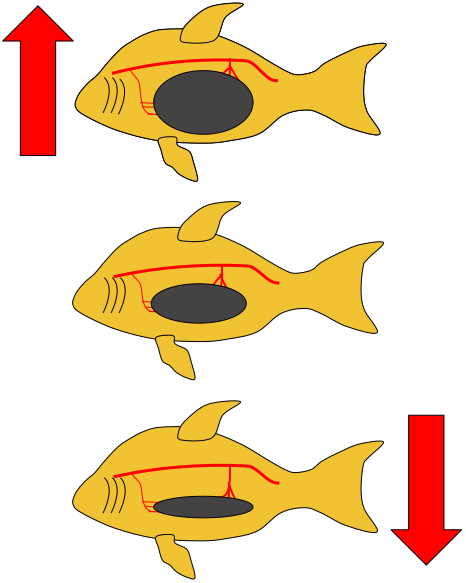
Many bony fish have a gas-filled organ called a swim bladder. NOAA explains that many fish use swim bladders to control stability and buoyancy in the water column.
The swim bladder is located inside the body and can contain gases that are regulated by the fish. By changing the volume of gas in the bladder, a fish can alter its overall density and therefore its buoyancy.
When the swim bladder contains more gas, the fish becomes more buoyant. When the gas volume is reduced, the fish becomes less buoyant.
This allows many fish to maintain a position in the water without constantly swimming just to avoid sinking.
Why Is a Swim Bladder So Useful?
Imagine a fish that had to swim continuously just to remain at the same depth. Maintaining that position would require energy even when the fish was not traveling anywhere.
A swim bladder can reduce that problem by helping the fish adjust its buoyancy.
The exact structure and control mechanism varies among fish species. Some fish can regulate gases through specialized physiological processes, while others have a connection between the swim bladder and digestive tract.
Therefore, it is more accurate to say that many bony fish use swim bladders than to suggest that every fish has one.
Why Doesn't Every Fish Have a Swim Bladder?
Fish are an extremely diverse group, and buoyancy adaptations differ among species.
Sharks, rays, and skates, for example, are cartilaginous fish and do not have the swim bladder found in many bony fish. Other fish also have different strategies for controlling their position in the water.
Some fast-swimming species rely more heavily on body composition and continuous movement rather than depending on a gas-filled organ for buoyancy.
This diversity shows that there is no single solution to the problem of staying at the right depth.
Why Don't Sharks Have Swim Bladders?
Sharks belong to a group of fish called elasmobranchs. Their skeletons are made primarily of cartilage rather than the mineralized bone found in bony fish.
Sharks also lack swim bladders. Instead, their bodies have several characteristics that help reduce the energetic cost of staying in the water.
NOAA Fisheries explains that sharks have lightweight cartilaginous skeletons and large livers containing low-density oils, both of which contribute to buoyancy.
However, sharks are not simply floating neutrally in the same way a fish with a perfectly adjusted swim bladder might. Hawaiian shark researchers note that sharks are generally slightly negatively buoyant, meaning they tend to sink and must compensate through their anatomy and swimming behavior.
How Does a Shark's Liver Help With Buoyancy?
One of the most important features involved in shark buoyancy is the liver.
Shark livers can contain large amounts of low-density oil. Because the oil is less dense than seawater, it contributes to the shark's ability to remain higher in the water than it would otherwise.
The liver does not act like a giant swim bladder. Instead, it is part of a broader system involving the shark's skeleton, body shape, fins, and swimming movements.
The lightweight cartilage of a shark also contributes to reducing overall body density. Together, these characteristics help compensate for the absence of a gas-filled swim bladder.
Why Do Sharks Still Need to Swim?
Buoyancy and swimming are closely connected in sharks.
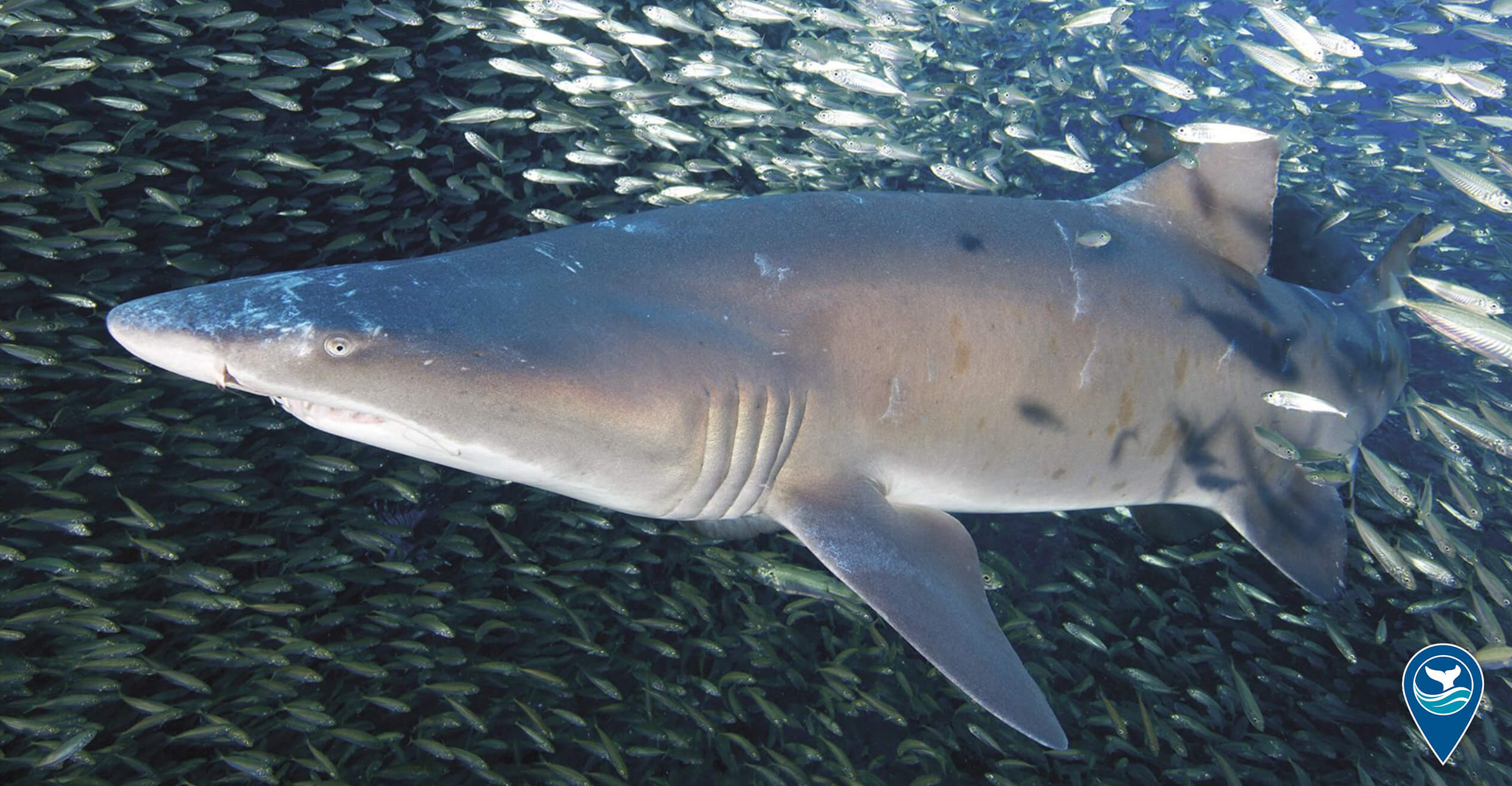
Because sharks generally tend to be slightly negatively buoyant, swimming can help them maintain their position in the water. Their fins and body shape also generate hydrodynamic forces that contribute to lift as the animal moves.
However, it would be inaccurate to say that every shark must swim continuously or it will immediately sink and die.
Some shark species can remain stationary while using different mechanisms to move water across their gills. Others are more dependent on continuous swimming for respiration and movement.
Therefore, the relationship between swimming and buoyancy varies among shark species.
How Do Whales Stay Buoyant?
Whales face a completely different buoyancy problem because they are mammals rather than fish.
They do not have swim bladders. Instead, their buoyancy is influenced by their body composition, including muscle, bone, organs, and fat.
Blubber is particularly important because it is composed largely of fatty tissue and can contribute to buoyancy. NOAA Ocean Today notes that blubber in gray whales helps with both insulation and buoyancy.
However, whales do not simply float because they have blubber. Their bodies are dynamic systems, and buoyancy can vary depending on the species, body composition, depth, and amount of air in the lungs.
Whales also actively control their position through swimming and diving movements.

What About Seals and Sea Lions?
Seals and sea lions also have no swim bladder because they are marine mammals.
Their buoyancy is affected by their body composition, including fat stores and the amount of air in their lungs.
They can also control their position by swimming with their flippers and adjusting their diving behavior.
For diving mammals, buoyancy can actually become part of the strategy for moving through the water. Depending on the animal and its body composition, sinking can sometimes help with descending while active swimming is used when necessary to control direction and depth.
This is one reason why buoyancy should not always be thought of as something animals simply want to maximize. What matters is control.
Why Is Neutral Buoyancy Useful?
Neutral buoyancy can be particularly useful for animals that spend long periods at a particular depth.
A fish hunting in the middle of the water column, for example, benefits if it does not have to constantly swim upward to counteract sinking.
Reducing unnecessary movement can save energy.
This becomes especially important in environments where food is scarce or where an animal needs to reserve energy for migration, reproduction, escaping predators, or hunting.
Buoyancy therefore works together with other adaptations rather than functioning as an isolated survival mechanism.
Buoyancy Can Change With Depth
One of the most important complications is that water pressure changes as an animal moves deeper.
Gas is compressible, so a gas-filled structure such as a swim bladder becomes smaller as surrounding pressure increases.
This means a fish with a swim bladder does not experience exactly the same buoyancy conditions at every depth.
Rapid changes in depth can therefore create physiological challenges for fish with gas-filled organs. This is one reason sudden changes in pressure can contribute to a condition known as barotrauma in some fish.
Animals adapted to different depths have different ways of managing these changes, and not every species responds to pressure in the same way.
Buoyancy Strategies Across Ocean Animals
| Animal group | Main buoyancy strategy | Why it helps |
|---|---|---|
| Many bony fish | Gas-filled swim bladder | Helps regulate buoyancy and maintain position in the water column |
| Sharks and rays | Oil-rich liver, lightweight cartilage and swimming-related lift | Helps compensate for the absence of a swim bladder |
| Whales | Body composition, blubber and active swimming | Influences buoyancy during swimming and diving |
| Seals and sea lions | Body composition, lung air and active swimming | Allows control of position during diving and movement |
Is Buoyancy the Same as Floating?
Not exactly.
When people hear the word “buoyancy,” they may imagine an object floating at the surface like a piece of wood.
But an animal can be buoyant while remaining completely underwater.
In fact, many aquatic animals benefit from controlling their position within the water column rather than simply floating on the surface.
A fish may remain several meters below the surface while balancing gravity and buoyancy. A whale may descend during a dive and later return toward the surface. A shark may use swimming-generated lift while its body naturally tends to sink.
The important factor is not simply whether an animal floats. It is how effectively the animal controls its position in three-dimensional water.
Why Buoyancy Matters for Ocean Survival
The ocean is a three-dimensional environment.
Animals do not only move forward, backward, left, or right. They also move vertically through the water column.
Different depths can provide different temperatures, prey, predators, oxygen levels, light conditions, and habitats.
Being able to control depth therefore gives animals access to different parts of their environment.
For a predator, the right depth may place it closer to prey. For a migrating animal, changes in buoyancy can affect the energy required to descend or ascend. For a fish resting in the water column, efficient buoyancy control can reduce the amount of energy spent simply staying in place.
Buoyancy Is an Adaptation, Not a Single Trick
There is no universal buoyancy system shared by all ocean animals.
Many bony fish use gas-filled swim bladders. Sharks use a combination of anatomy and swimming. Whales and other marine mammals rely on body composition, air, and movement.
Even within the same broad animal group, species can differ substantially.
This is an important lesson in animal adaptation: evolution does not produce one solution for every species. Instead, different animals develop different ways of dealing with the physical demands of their environments.
Why Ocean Buoyancy Is Such an Important Adaptation
Staying at the right depth may look simple from the outside, but it involves a continuous interaction between gravity, water pressure, body composition, anatomy, and movement.
For many fish, the swim bladder provides a highly effective way to adjust buoyancy. For sharks, the absence of a swim bladder is compensated for by other anatomical features. For whales and seals, body composition and diving physiology help them manage life in a medium that is very different from the land environment where their ancestors lived.
These strategies show how closely animal bodies are connected to the physical properties of their habitats.
The ability to control buoyancy is therefore more than simply “floating.” It is a major part of how many ocean animals move, feed, rest, migrate, and survive.
Conclusion
Ocean animals stay afloat—or more accurately, control their position in the water—in remarkably different ways.
Many bony fish use swim bladders to regulate buoyancy. Sharks lack these gas-filled organs and instead rely partly on their lightweight cartilaginous skeletons, oil-rich livers, and swimming-related lift. Whales and other marine mammals manage buoyancy through their body composition, fat stores, lung air, and active movement.
These adaptations allow animals to navigate the ocean's three-dimensional environment while reducing the energy required to control their depth.
Buoyancy may be invisible to us, but for animals living underwater, it is a constant physical force—and evolution has produced many different ways to work with it.
Test Your Knowledge
1. What is a swim bladder?
A. A muscle used for swimming
B. A gas-filled organ found in many bony fish
C. A special type of gill
D. An organ used to digest food
2. Why don't sharks use swim bladders?
A. Sharks do not need buoyancy
B. Sharks are marine mammals
C. Sharks lack the swim bladder found in many bony fish
D. Sharks can breathe underwater without gills
3. What feature of sharks contributes to buoyancy?
A. An air-filled lung
B. A large oil-rich liver
C. A hollow skeleton filled with air
D. A floating shell
4. Why is buoyancy useful to many ocean animals?
A. It can reduce the energy needed to maintain position in the water
B. It allows animals to live without oxygen
C. It prevents all pressure changes
D. It eliminates the need to swim
Answers
1. B — A gas-filled organ found in many bony fish. Swim bladders help many fish regulate their buoyancy in the water column.
2. C — Sharks lack the swim bladder found in many bony fish. Sharks instead use other anatomical and swimming adaptations to manage their position in the water.
3. B — A large oil-rich liver. Low-density oils in the liver contribute to shark buoyancy.
4. A — It can reduce the energy needed to maintain position in the water. Efficient buoyancy control can reduce the amount of continuous swimming required simply to remain at a particular depth.
More From The Pader
How Ocean Animals Survive: The Incredible Adaptations That Help Them Live Underwater
How Deep-Sea Animals Survive in Darkness and Extreme Pressure
How Whales Sleep Without Drowning: The Science Explained
Sources and Further Reading
NOAA Ocean Service — How Do Scientists Locate Schools of Fish?
NOAA Fisheries — 12 Shark Facts That May Surprise You
Hawaiʻi Department of Land and Natural Resources — Skeleton & Buoyancy
NOAA Ocean Today — Whale Anatomy
Wikimedia Commons — Fish Swim Bladder.svg
Status: FACT-CHECKED
The article was reviewed against NOAA, Smithsonian Ocean, Hawaiʻi Department of Land and Natural Resources, NOAA Ocean Today, and verified Wikimedia Commons image records. The main claims concerning swim bladders, shark buoyancy, cartilaginous skeletons, oil-rich livers, and marine-mammal buoyancy are supported by these sources.
The article does not treat buoyancy as identical across all ocean animals. Many bony fish have swim bladders, but not every fish does. Sharks generally tend to be slightly negatively buoyant, and their ability to remain in the water column involves both anatomy and swimming. Marine-mammal buoyancy also varies with species, body composition, lung air, depth, and behavior.
The Pader presents wildlife and science information using credible sources and accessible language. Scientific information may be updated as new research emerges.
0 comments:
Post a Comment